
Growth teams and engineering departments don’t run into Mailjet’s ceiling overnight; it tends to surface at exactly the wrong moment. A product launch floods your queue past the daily sending threshold. A shared IP pool running cold from a weekend marketing blast holds up your Monday morning password reset emails. A visual workflow editor that stops at basic linear sequences when your customer journey demands conditional branching.
These aren’t edge cases. They’re operational reality for any company running both a customer-facing email newsletter and a developer-triggered transactional system from the same sending infrastructure.
The demand for credible Mailjet Competitors has grown precisely because modern infrastructure requirements don’t fit neatly into a single-tier solution. Your SRE team needs documented delivery SLAs and granular webhook logs for system notifications. Your marketing team needs a drag-and-drop email builder that doesn’t break table rendering in Outlook 2019. And both need to operate under European GDPR compliance without legal creating a friction storm every time you expand your subscriber list.
This article breaks down eight platforms that actually solve one or both of those problems without hand-waving over the parts that matter.
Evaluating the Delivery Gap: Hybrid Platforms vs. Developer-First APIs
Before picking a replacement, understand what you’re replacing at the architecture level.
The ESP market splits cleanly into two categories. On one end: pure SMTP relay service engines built for developer platforms like Postmark and Mailgun that exist to fire a transactional email API request, log it, and prove delivery. On the other end: full-stack customer engagement platforms that bundle marketing automation workflows, CRM functionality, landing pages, and SMS into a single subscription.
Mixing transactional and marketing traffic on the same unmonitored IP pool is a deliverability gamble most teams discover too late.
Delivery architecture note: When a marketing broadcast to a cold segment triggers a spike in unsubscribes and spam complaints, those signals are attributed to your sending IP. If your password reset and order confirmation emails share that same IP, your email deliverability rate for transactional messages falls, often invisibly, because SMTP error logs don’t surface soft reputation damage until it’s become a hard block. Dedicated IP streams, isolated by traffic type, and paired with email validation tools that scrub inactive or invalid addresses from your lists before sending, are the minimum-viable separation strategy for any serious sending volume.
The platforms that handle this well don’t just claim IP isolation; they give you observable proof. Log-level delivery events, per-stream reputation dashboards, and bounce categorization that distinguishes network timeouts from domain-level rejections.
Before the Start top 8 list, check out our top Email Marketing Software for Nonprofits
Top 8 Mailjet Competitors for High-Volume Inboxing
Brevo: European Multichannel Titan Built on a Volume-Based Pricing Model
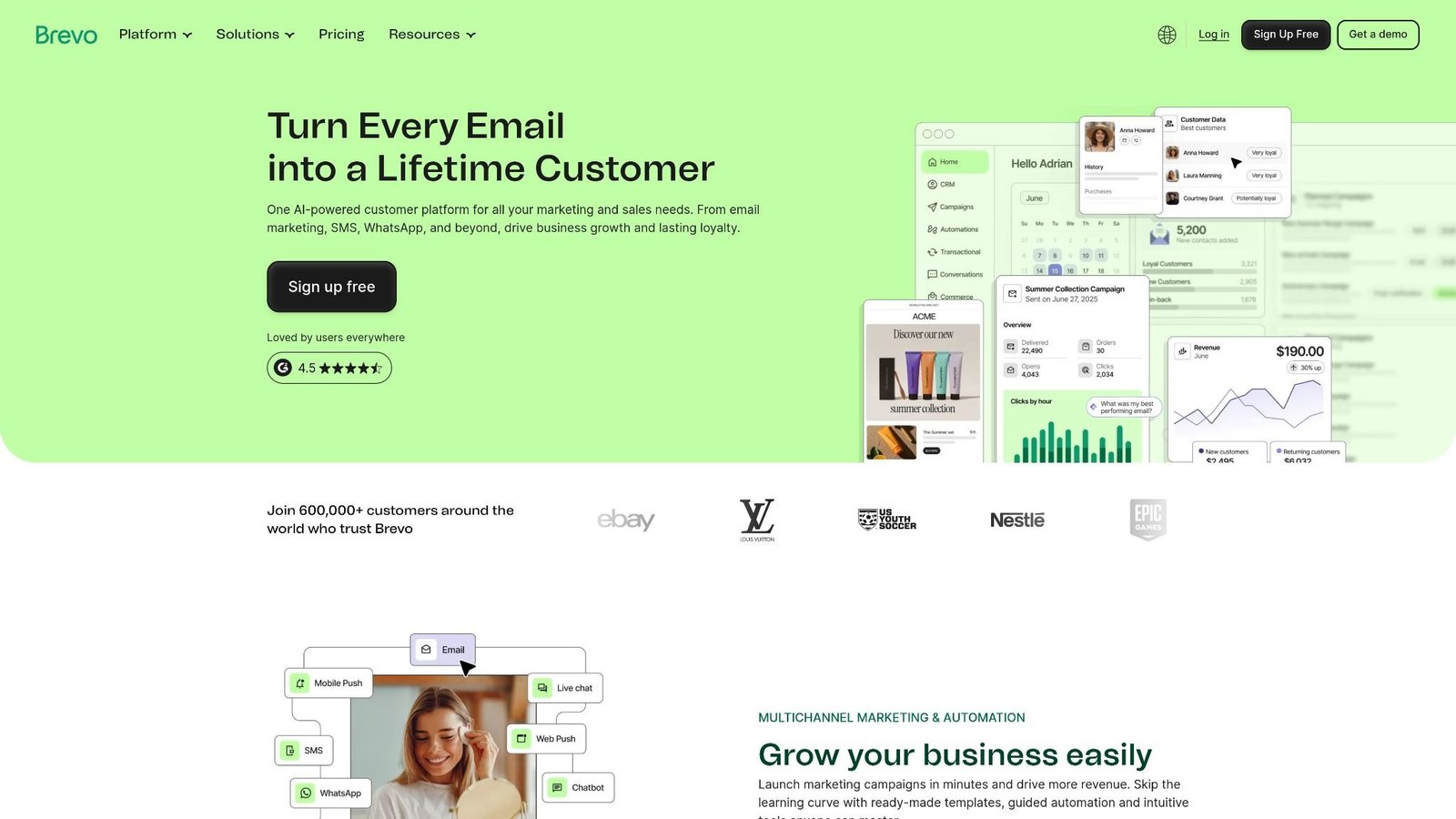
Brevo is one of the few platforms that solves the GDPR problem at the infrastructure level, not the paperwork level. Servers hosted in the EU, data processing agreements baked into onboarding, and a legal team that’s built the compliance layer for French enterprise clients rather than bolting it on afterward.
The differentiator that makes it worth examining for growing teams isn’t compliance; it’s the volume-based pricing model. Where most platforms charge you per contact stored (meaning list growth directly increases your monthly bill before you’ve sent a single email), Brevo charges per email sent. A 200,000-contact list costs the same to maintain as a 20,000-contact list if you’re only sending to 10,000 of them this month.
Native feature contrast vs. single-channel SMTP services:
| Brevo Native | Traditional SMTP | Gap Closed |
| SMS, WhatsApp, CRM, transactional email | Email sending only | Single subscription for multichannel |
| Contact scoring + pipeline management | No CRM layer | Marketing-to-sales handoff built-in |
| Landing pages + signup forms | No lead capture | Full acquisition loop without third-party tools |
The Edge: EU-native infrastructure with genuine multichannel depth: SMS, WhatsApp, and CRM in one platform at email-tier pricing.
The Infrastructure: Dedicated IP pools available from Starter tier upward. Transactional API supports both SMTP relay and REST, with per-message delivery webhooks. SPF/DKIM setup is wizard-guided, not documentation-hunted.
The Catch: The marketing automation workflows top out in sophistication at the mid-tier. If you need multi-branch behavioral sequences with conditional wait steps and lead scoring triggers, the workflow builder starts to feel constrained compared to ActiveCampaign. The contact deduplication logic also needs babysitting on large imported lists.
Mailgun: The Developer Heavyweight for Enterprise Transactional Email API Performance
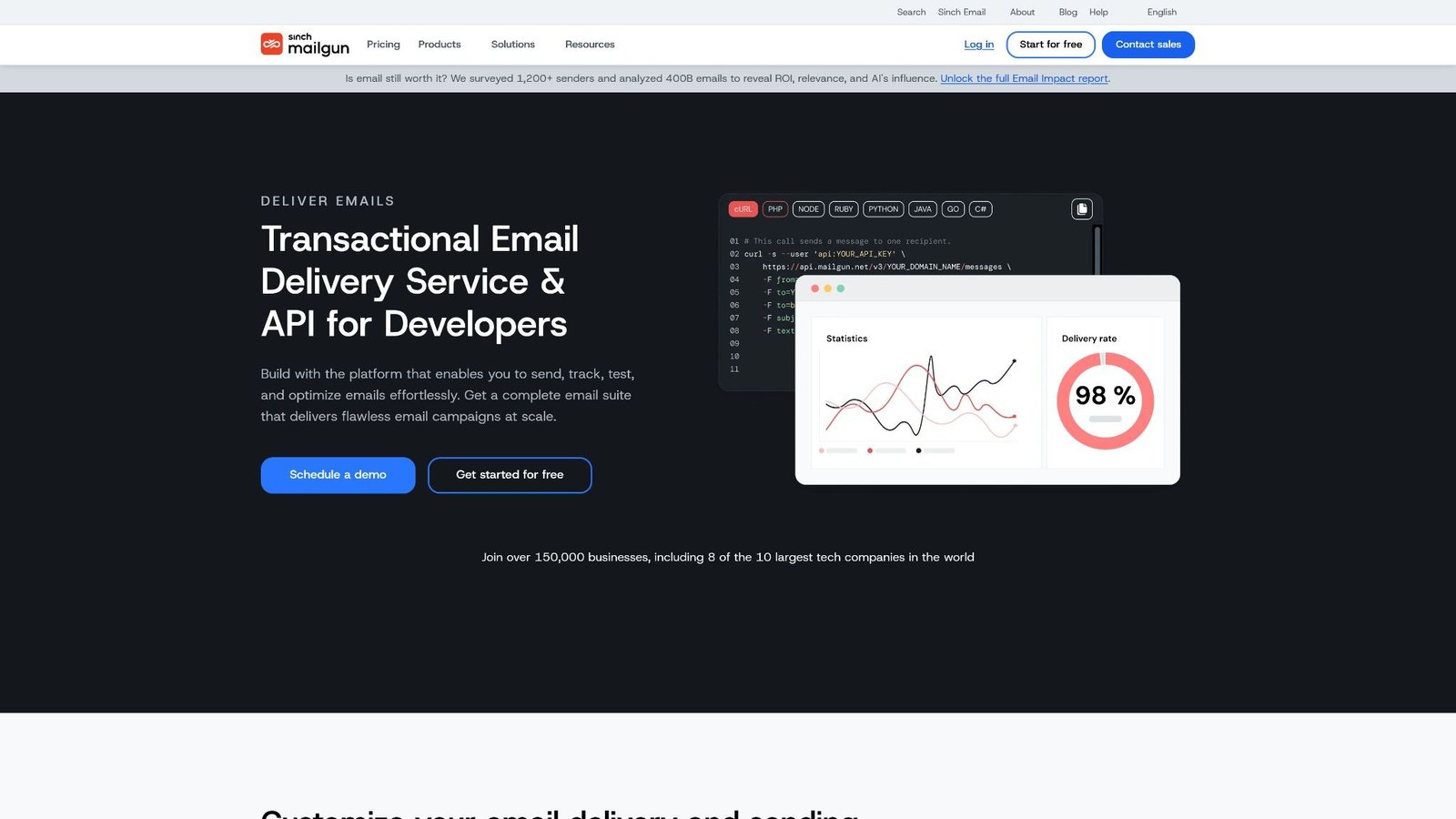
Mailgun doesn’t pretend to be a marketing platform. That’s the point.
The Edge: The transactional email API is built for engineers who need receipts. Every sent message generates a delivery event log accessible via API or webhook: accepted, delivered, failed, opened, clicked, complained, unsubscribed, all timestamped to the millisecond. For SaaS application teams tracking notification delivery as a product metric, this granularity is worth the price differential alone.
The Infrastructure: Mailgun’s email validation tools sit at the API layer, letting you validate an address before queuing the message, not after a bounce degrades your sender score. Dedicated IP warm-up is structured and documented. The SMTP relay service handles tens of millions of messages per month for enterprise clients without queue delays. Regional sending endpoints for US and EU traffic keep data residency compliant.
The Catch: No native drag-and-drop email builder. If your marketing team needs to build and send campaign newsletters, Mailgun is not the answer, or it’s half the answer, paired with a dedicated marketing tool. Pricing for high-volume dedicated infrastructure climbs fast, and the free tier daily caps are tight enough to limit meaningful testing at real sending velocity.
Postmark: Industry-Leading Speed for Mission-Critical Notifications
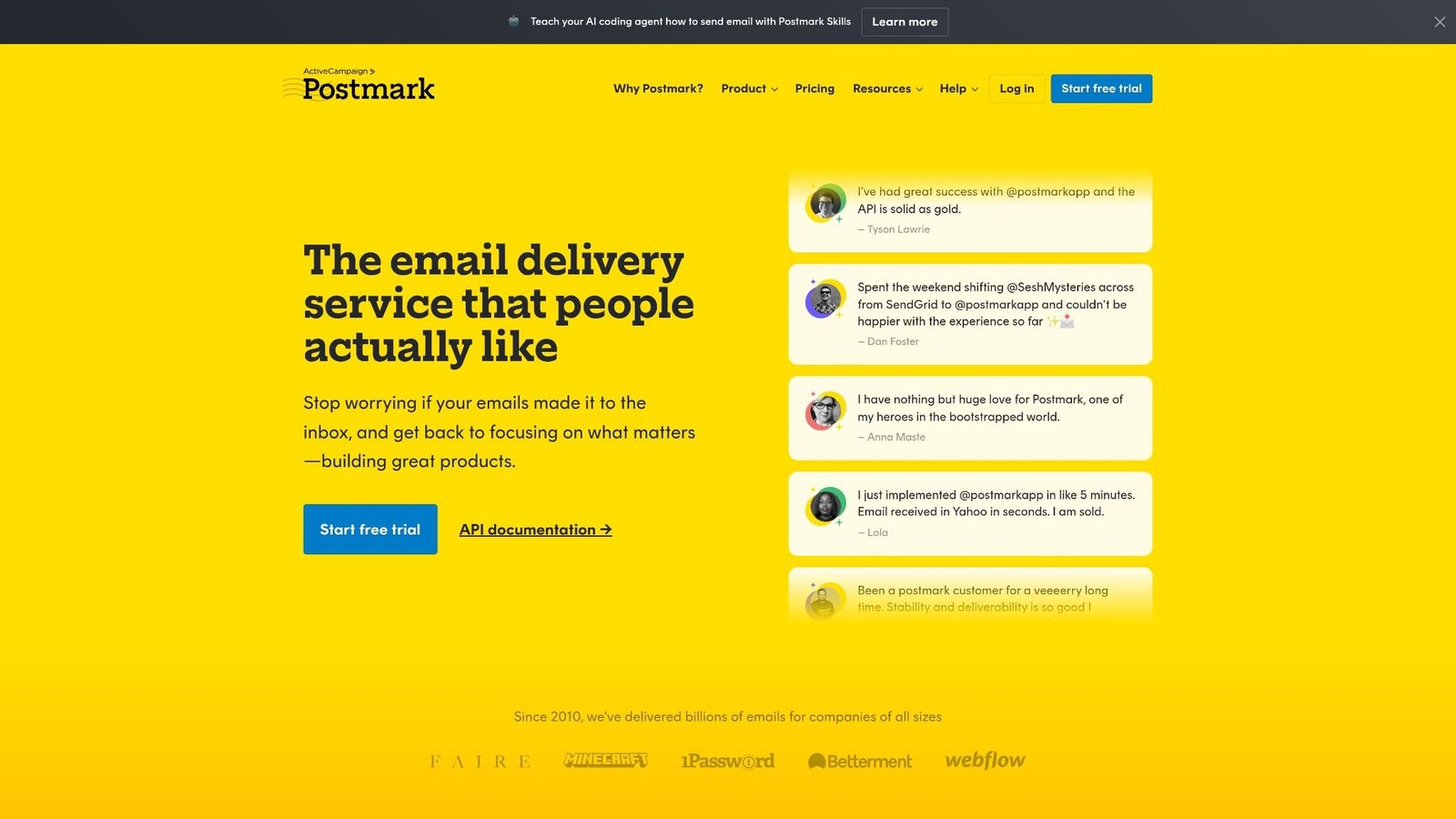
Postmark makes a single, unflinching promise: your transactional email will reach the inbox fast. Not “generally fast” measured fast.
The platform publishes delivery speed benchmarks and makes a hard architectural commitment: zero marketing email allowed through Postmark infrastructure. Every customer on the platform is sending transactional messages only. That shared constraint keeps IP reputation clean across the board. There’s no scenario where someone else’s discount broadcast degrades your password reset delivery.
The email deliverability rate on Postmark transactional streams consistently benchmarks above 99% inbox placement in independent audits. For SaaS products where a delayed account confirmation email means a lost signup, that number isn’t just a marketing stat; it’s a revenue number.
Message streams let you separate notification types (transactional vs. broadcast) with distinct suppression lists and bounce handling. The API is developer-friendly with client libraries for every major language. Where Postmark loses points: there is no marketing campaign builder. Full stop. If you need both, Postmark handles your system emails while something else handles your newsletter.
MailerLite: Intuitive Workflows and Budget-Friendly Marketing Automation Workflows
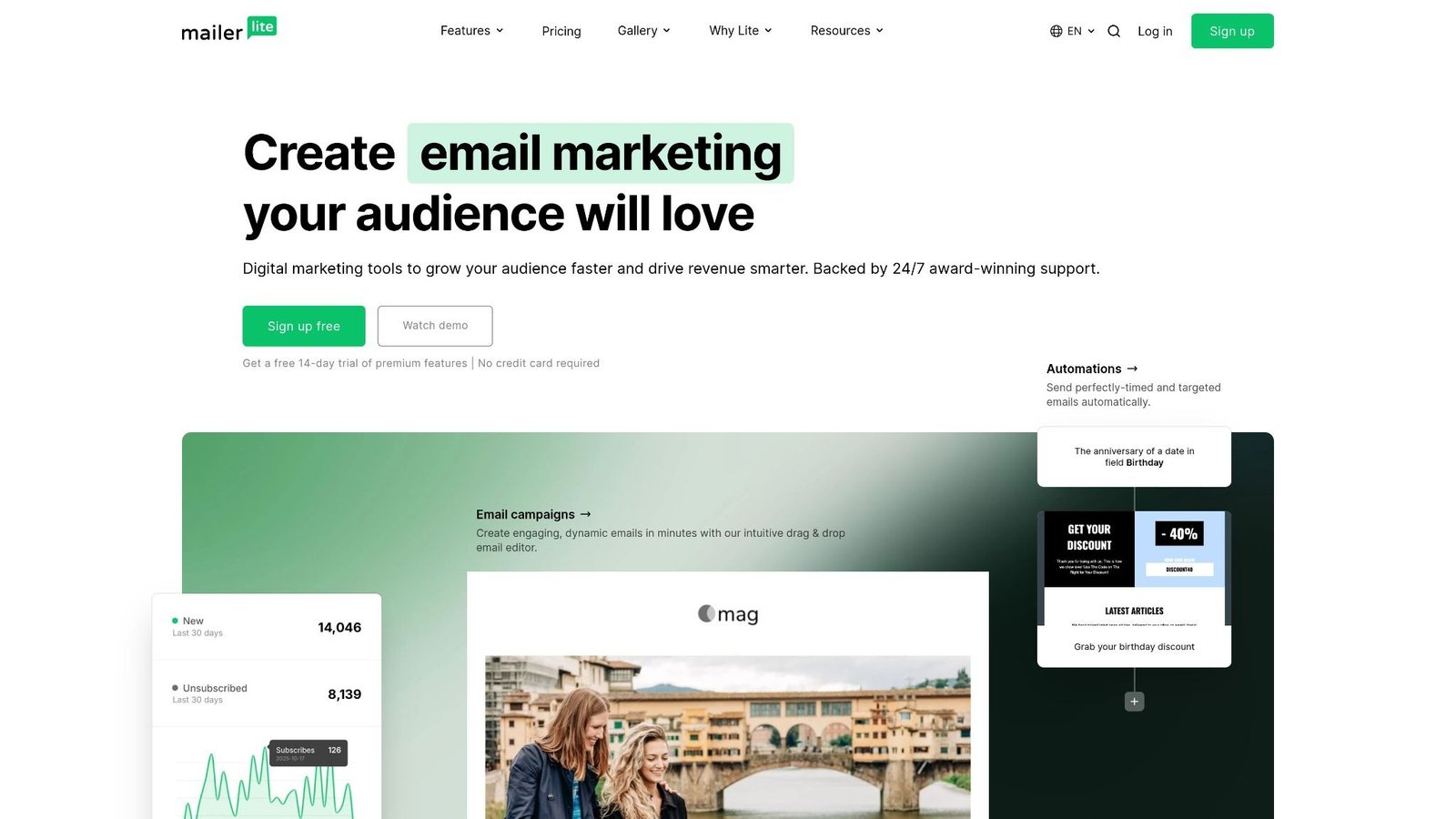
MailerLite operates in a different quadrant of the market: not developer-first, not enterprise-grade, but genuinely excellent for content creators, newsletters, and small businesses running their own campaigns without an engineering team on standby.
The drag-and-drop email builder is one of the cleanest in this list. Blocks snap predictably, mobile preview is accurate, and the template library covers enough starting points that you’re not starting from a blank canvas every time. The marketing automation workflows handle the core use cases: welcome sequences, tag-based segmentation, RSS-to-email publishing — without the setup complexity that mid-market platforms impose.
Pricing holds up well for subscriber-tier growth, though the free plan’s daily sending cap requires planning around campaign send times. The SMTP relay service for transactional messages is present but not the platform’s strength if you’re routing app-triggered emails through MailerLite; set delivery monitoring expectations accordingly.
For a solo operator or small team that wants a genuinely usable interface without a six-week onboarding process, MailerLite earns its place in the shortlist.
ActiveCampaign: Enterprise Customer Journey Orchestration and CRM Intelligence

ActiveCampaign is not an email platform with some CRM features bolted on. It’s a customer data platform that happens to send email, and the distinction matters.
The automation builder handles multi-branch conditional logic, behavioral triggers from website event tracking, lead scoring rules, and CRM pipeline stage changes as automation entry points. If a contact visits your pricing page three times, opens two emails, but hasn’t booked a demo call, you can build a sequence that responds to that exact behavioral pattern with targeted outreach. That’s not a setting; it’s a workflow you build, and the workflow builder is sophisticated enough to actually construct it.
GDPR compliance tooling includes consent field management, audit logs, and data export/deletion request handling. The transactional email coverage exists but is secondary; ActiveCampaign is at its best when the value comes from behavioral data shaping marketing decisions, not from raw email throughput.
The price climbs at scale, and the onboarding investment is real. But for complex B2B sales pipelines where the customer journey spans weeks and multiple touchpoints, the platform earns its license cost.
GetResponse: All-in-One Growth Platform with Integrated Lead Generation Tools
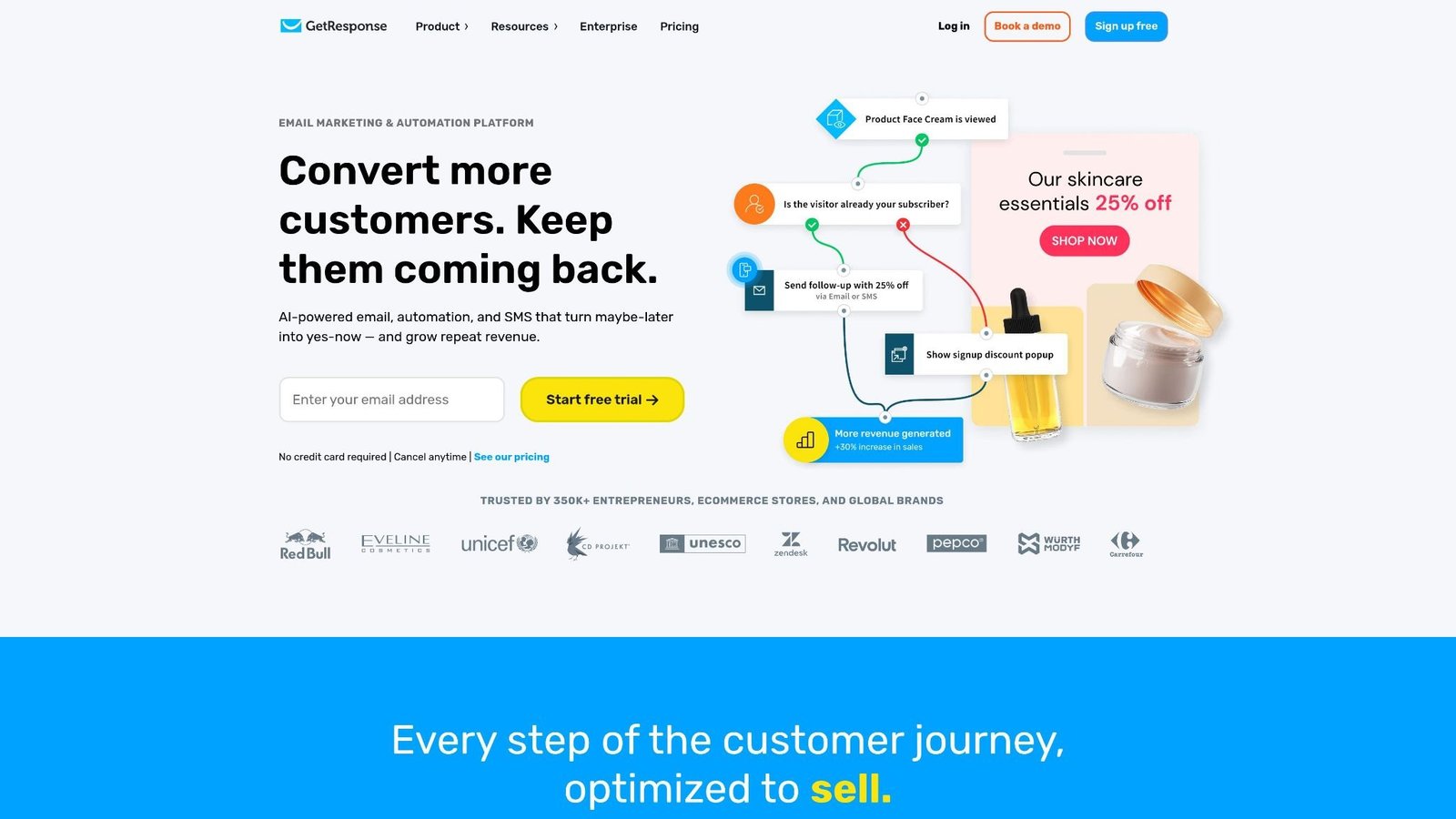
GetResponse stacks more into a single subscription than most teams will fully use. Email campaigns, marketing automation workflows, landing pages, sales funnels, paid ad managers, and native webinar hosting all under one login.
The appeal is consolidation. If you’re currently stitching together three or four tools to run a webinar, capture attendee emails, and trigger a post-event nurture sequence, GetResponse collapses that stack. The volume-based pricing model at higher tiers is reasonable, and the drag-and-drop email builder handles standard campaign layouts without surprises.
Where GetResponse is less impressive: depth. Each feature sits a tier below what a dedicated specialist tool delivers. The webinar tool isn’t Zoom. The landing page builder isn’t Unbounce. The email automation isn’t ActiveCampaign. If you need the best-in-class version of any single capability, GetResponse probably isn’t it. If you need good-enough across all of them without managing multiple vendor relationships, it’s a legitimate choice.
Moosend: High-Value Automation and E-Commerce Invoicing Simplicity
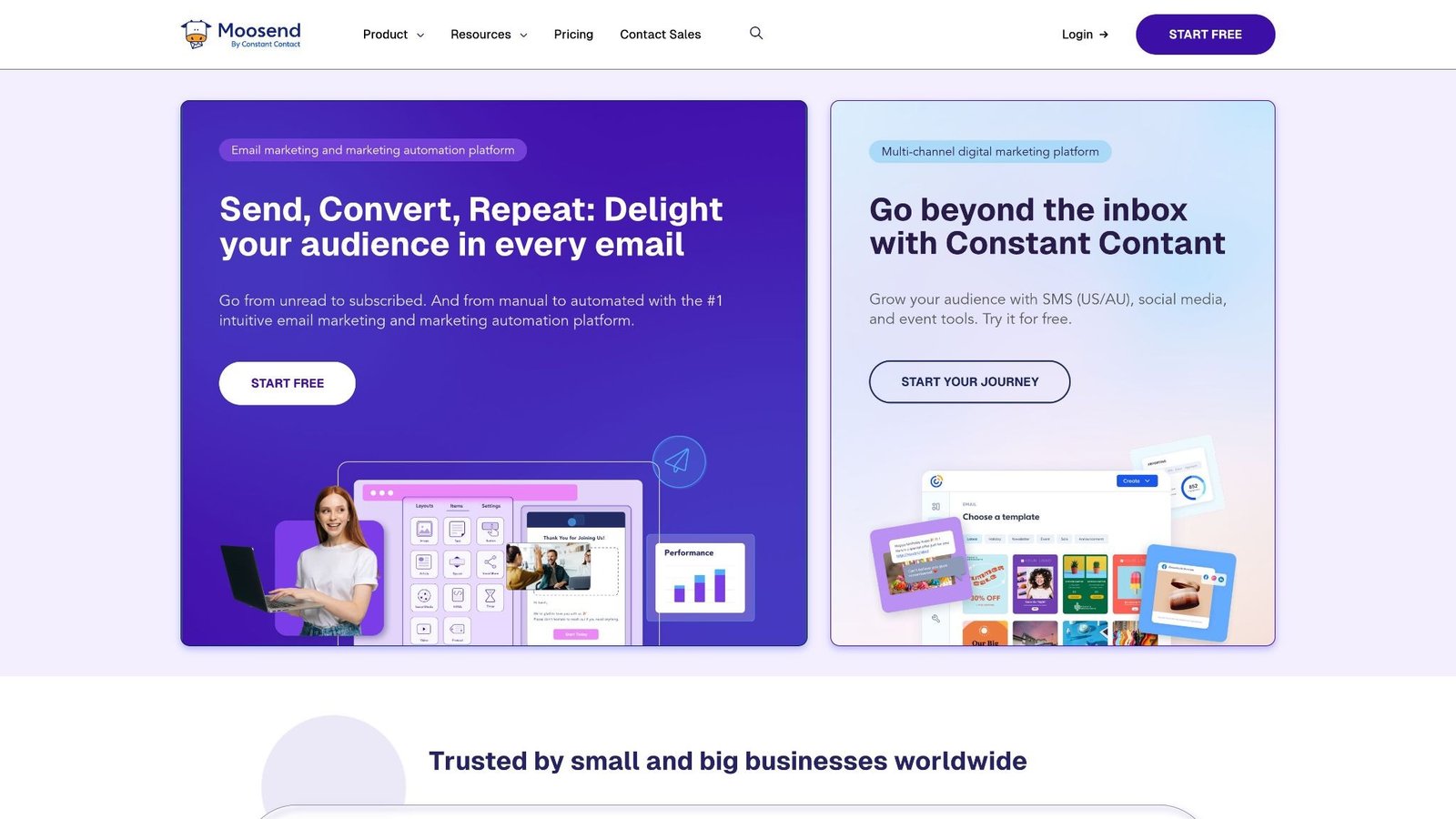
Moosend punches above its price point. The drag-and-drop email builder supports dynamic content blocks, product recommendations, countdown timers, and personalized fields that typically require higher-tier subscriptions on competing platforms. Cart recovery automation triggers reliably on e-commerce store events, and the setup doesn’t require a developer to wire up basic Shopify or WooCommerce integrations.
The AI subject line testing tool runs variant analysis that gives you directional signal without needing a statistically significant subscriber list to see useful results. Reporting covers opens, clicks, revenue attribution for e-commerce sends, and heatmaps on link placement.
The platform lacks the depth of Mailgun’s transactional email API logging for developer teams. But for a mid-size e-commerce business that wants behavioral automation, cart recovery, and product email campaigns without enterprise pricing, Moosend is one of the more honest value propositions in this market.
AWeber: Rock-Solid Deliverability and Support for Small Business Owners
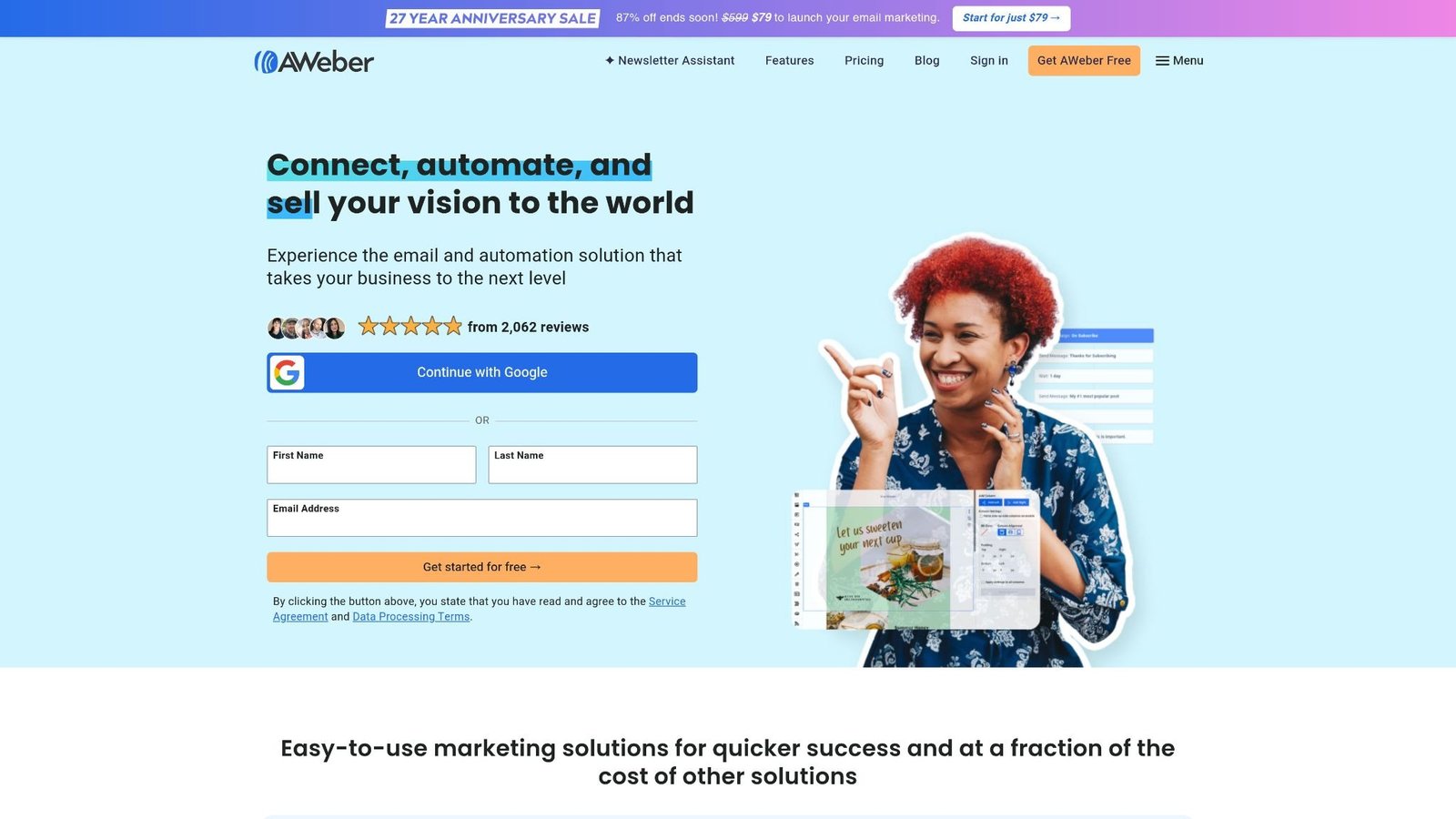
AWeber has been sending emails since 1998, and the inbox reputation built over that history is the primary reason to choose it. The sender score is genuinely maintained by decades of conservative list hygiene standards, double opt-in defaults, and proactive spam complaint monitoring.
The feature set is deliberately simple. RSS-to-email publishing, autoresponder sequences, a template library, and a drag-and-drop email builder that prioritizes stability over innovation. If you’ve been burned by a platform pushing updates that break existing template rendering, AWeber’s conservative release cadence is a feature, not a limitation.
24/7 human customer support via phone, live chat, and email separates it from platforms that route everything through a ticketing system with 48-hour response windows. For small business owners without an IT team and marketing automation experience, that support access is worth real money when a campaign goes sideways at 9 pm on a Tuesday.
The SMTP relay service for transactional volume is basic. AWeber is not the answer for a SaaS app firing thousands of system notifications per hour. It is the answer for a local business that wants reliable newsletters and a support line that picks up.
Architectural Decision Matrix: Selecting from Top Mailjet Competitors
The selection framework comes down to one question before any feature comparison: what percentage of your sending volume is transactional versus marketing?
If transactional email API reliability is the primary requirement– SaaS apps, marketplace order flows, authentication emails the answer is Postmark (for absolute delivery speed and IP purity) or Mailgun (for engineering-grade logging, webhook depth, and validation tooling at scale). Both require dedicated marketing infrastructure to sit alongside them.
If marketing automation workflows are the primary requirement– customer nurture sequences, behavioral triggers, CRM integration the spectrum runs from MailerLite (simple, affordable, no engineering overhead) to ActiveCampaign (complex, expensive, powerful enough to justify the investment for high-touch B2B funnels).
If GDPR compliance and contact list growth are the constraints, Brevo’s EU-native infrastructure and volume-based pricing model remove both friction points simultaneously. It’s not the deepest tool in any single category, but the breadth and the data residency compliance make it the default recommendation for European businesses scaling their first multichannel stack.
If budget is the binding constraint, Moosend and MailerLite both deliver genuine functionality at pricing that doesn’t require a finance approval process. Neither is a compromise you’ll regret at 10,000 subscribers.
Final Takeaways on Evaluating Mailjet Competitors
Before you migrate, run this audit sequence:
1. Pull your last 90 days of bounce data. Categorize hard bounces (invalid addresses) from soft bounces (temporary delivery failures). A high hard bounce rate means your list needs email validation tools before it touches a new platform; otherwise, you import the damage.
2. Export every active template. Test rendering in your new platform’s editor before you go live. Table-based layouts, dynamic merge tags, and conditional content blocks behave differently across builders. Don’t discover the rendering gap mid-campaign.
3. Set up SPF/DKIM records before your first send. Every platform in this list supports both. Most deliverability problems on new accounts trace to missing or misconfigured DNS authentication. Verify with a dedicated mail-tester tool, not just a confirmation screen from your ESP.
4. Audit your IP strategy. If you’re sending more than 50,000 emails per month, request a dedicated IP and plan a warm-up schedule. Cold dedicated IPs with sudden volume look like spam to receiving mail servers regardless of list quality.
5. Migrate gradually. Run old and new infrastructure in parallel for two to four weeks. Watch your email deliverability rate on the new platform against historical benchmarks before cutting over fully.
The right choice among these Mailjet Competitors depends on your current bottleneck, not on feature comparison tables. Identify what’s actually breaking, and let that determine the architectural direction.
FAQs
Why do developers look for Mailjet Competitors when building SaaS applications?
The primary friction points are daily sending caps on lower tiers, limited webhook event granularity, and SMTP authentication flows that don’t expose enough debug information when delivery fails silently. Developer teams building SaaS products need per-message delivery state accepted, queued, deferred, and bounced accessible via both webhook push and API pull, at high throughput, without hitting rate limits that block authentication emails during signup surges. Mailgun and Postmark are the platforms most commonly benchmarked against Mailjet in developer evaluations for exactly these capabilities.
Is it better to separate transactional emails from marketing campaigns on different IP addresses?
Yes, and it’s not a marginal improvement. When a marketing campaign generates complaint rates above 0.1%, the sending IP absorbs reputation damage. If transactional emails share that IP, inbox placement for password resets, order confirmations, and account alerts drops in parallel. Dedicated IP streams per traffic type prevent one channel’s performance from cannibalizing the other. Platforms like Postmark enforce this separation by contract. Others, like Mailgun and Brevo, let you configure it manually with message streams or dedicated IP pools.
How does a volume-based pricing model differ from contact-based email billing?
Contact-based billing charges you for every address in your database, whether you email them or not. A 100,000-contact list costs more than a 20,000-contact list even if you’re sending to the same 5,000 active subscribers each week. A volume-based pricing model charges per email sent, not per contact stored. For businesses with large historical lists and varied sending frequency, this distinction can represent a 40–60% cost difference. Brevo and Moosend use volume-based models; most US-based ESPs default to contact-based tiers.
What are the best Mailjet alternatives hosted natively in the EU for GDPR compliance?
Brevo is the most mature EU-native option with full multichannel capability and a documented data processing agreement built for French enterprise compliance requirements. MailerLite processes data in the EU and offers a DPA. Sendinblue (now rebranded as Brevo) has historically been the default recommendation for legal teams requiring data residency within EU borders. Any platform used for GDPR-regulated lists should provide: a signed DPA, documented subprocessor lists, data export and deletion workflows, and server infrastructure located within the EU.
Can an SMTP relay service be integrated into an existing custom web app without coding a full API?
Yes. Every major SMTP relay service in this list supports standard SMTP protocol authentication over port 587 or 465 with TLS. If your web application already has a mail-sending function, whether PHP’s mail(), Python’s smtplib, Node’s nodemailer, or a framework-level mailer, you replace the outgoing server hostname, port, and SMTP credentials with the provider’s values. No REST API integration required. The trade-off: native SMTP connections don’t expose the same per-message delivery event logging that REST API integrations provide. For full webhook-based delivery tracking, the API route is worth the additional implementation time.