Running a coworking space gets complicated long before you open a second location.
One day you’re managing 40 members with a spreadsheet. A few months later, you’re chasing failed payments, manually updating door permissions, juggling meeting room bookings, and answering the same “Is Desk 12 available?” question five times a day.
Those small operational tasks don’t just consume time. They create billing errors, reduce occupancy, frustrate members, and increase staff workload.
That’s where coworking membership management software becomes essential.
A dedicated platform does much more than let members reserve desks. It acts as the operational hub for your business, connecting memberships, automated recurring billing, resource scheduling, payments, door access control, and reporting into one system. Instead of stitching together multiple tools, operators gain a single source of truth for their entire workspace.
As flexible work continues to grow in 2026, member expectations are also changing. They expect instant bookings, mobile access, self-service account management, and frictionless check-ins. Meeting those expectations manually isn’t sustainable.
Whether you operate a boutique coworking space, a growing network of flexible offices, or a nationwide workspace brand, choosing the right platform can reduce admin overhead, improve member retention, and give you better visibility into how your space actually performs.
This guide compares seven of the best coworking membership management software platforms available today, highlighting their strengths, trade-offs, pricing models, and the types of operators they serve best.
Did you know about a healthcare visitor management system?
What Is Coworking Membership Management Software?
Coworking membership management software is an operational platform built specifically for flexible workspaces. It manages the entire member lifecycle, from onboarding and subscription management to workspace reservations, payments, and access permissions.
Unlike generic booking software, these platforms understand that coworking businesses operate on memberships rather than one-time reservations. Members may have different plans, monthly desk credits, meeting room allowances, guest passes, storage lockers, parking privileges, or access to multiple locations. Managing all of these manually quickly becomes difficult.
A modern platform brings these processes together in one place.
Instead of relying on separate tools for scheduling, invoicing, payment collection, and access management, operators can automate nearly every recurring task.
Typical capabilities include:
- Member registration and onboarding
- Subscription and plan management
- Automated recurring billing
- Desk and meeting room reservations
- Hot desking software with live availability
- Visitor management
- Community engagement
- Door access integrations
- Financial reporting
- Occupancy monitoring
- Multi-location operations
For operators, this means less time handling administrative work and more time improving the member experience.
For members, it creates a smoother journey. They can upgrade memberships, reserve workspaces, pay invoices, unlock doors, register guests, and join community events from a single portal or mobile application.
Basic Booking Plugins vs. Dedicated Coworking Management Platforms
| Basic Booking Plugins | Dedicated Coworking Management Platforms |
| Focus only on reservations | Manage the complete member lifecycle |
| Usually support one-time bookings | Built around recurring memberships and subscriptions |
| Manual billing | Automated recurring billing with invoicing |
| No membership plans | Multiple pricing tiers and flexible memberships |
| Limited reporting | Advanced occupancy analytics and revenue reporting |
| No access management | Native door access control integrations |
| Separate payment tools | Unified payment processing and subscriptions |
| Limited scalability | Designed for growing flex space management businesses |
The biggest difference is operational visibility. A booking plugin can tell you whether a meeting room is occupied. A coworking management platform can tell you:
- Which membership plans generate the highest recurring revenue.
- Which desks remain underutilized.
- Which meeting rooms have the highest demand.
- Which members are likely to churn.
- Which locations perform best.
- Where unused capacity can be monetized.
As your workspace grows, these insights become just as valuable as the booking functionality itself.
Core Features Every Flex-Space Operator Needs
Every coworking platform promises to simplify operations. The best ones actually remove repetitive work instead of shifting it elsewhere.
When evaluating software, don’t focus solely on attractive interfaces or long integration lists. Prioritize features that directly reduce manual work, improve operational visibility, and create a better experience for members.
Here are the capabilities that matter most.
Automated Billing & Plan Proration
Revenue is the engine of every coworking business, but it’s also one of the easiest areas for errors to creep in.
Members upgrade plans mid-month, purchase extra meeting room hours, pause memberships, or switch between dedicated desks and hot desks. Calculating these changes manually often leads to billing disputes and lost revenue.
Strong coworking software automates the entire billing cycle.
Look for platforms that support:
- Automated recurring billing
- Monthly and annual memberships
- Usage-based charges
- One-time purchases
- Add-on services
- Taxes and regional compliance
- Multiple payment gateways
Proration is especially important. If a member upgrades halfway through the month, the system should automatically calculate the remaining balance instead of requiring manual adjustments.
The same applies when members downgrade or cancel. Another essential capability is proration & dunning.
Dunning workflows automatically retry failed card payments, notify members of overdue invoices, and reduce involuntary churn caused by expired or declined payment methods.
Without these automations, staff often spend hours chasing invoices that software could recover automatically.
Key takeaway: The right billing engine protects recurring revenue while dramatically reducing manual finance work.
Desk & Meeting Room Reservation Engine
Reservation management sits at the center of every coworking operation. Members expect to see live availability, reserve workspaces instantly, and receive confirmations without waiting for staff approval.
A modern desk booking system should support:
- Hot desks
- Dedicated desks
- Private offices
- Phone booths
- Meeting rooms
- Event spaces
- Day passes
Advanced platforms also include interactive floor plans so members can choose specific desks rather than simply selecting “available.”
Meeting room reservation tools should provide:
- Real-time availability
- Hourly booking rules
- Credit-based reservations
- Buffer times between meetings
- Calendar synchronization
- Booking limits by membership tier
For operators, these features eliminate scheduling conflicts while increasing space utilization. For members, they create a predictable experience where availability is always visible before arriving.
Smart Access Control Integration
Manual key management doesn’t scale. Neither do physical access cards that require staff intervention every time a membership changes.
Modern coworking software integrates directly with door access control systems to automate entry permissions.
When a member joins, upgrades, pauses, or cancels a membership, the platform automatically updates access rights.
This allows operators to create rules such as:
- 24/7 access for premium members
- Business-hours-only access for day-pass users
- Meeting-room-only permissions
- Access to specific floors
- Multi-location permissions
- Temporary guest access
The biggest advantage is consistency. Billing, memberships, and physical access stay synchronized without staff involvement.
That reduces security risks while improving the overall member experience.
Also read: law firm intake software
Member Portal & White-Label Mobile App
Today’s members expect self-service. They don’t want to email reception every time they need to book a meeting room or download an invoice.
A strong member portal gives them control over everyday tasks while reducing support requests.
Look for platforms offering a white-label member app that allows operators to maintain their own branding while delivering a polished mobile experience.
Useful self-service features include:
- Membership management
- Invoice payments
- Desk booking
- Meeting room reservation
- Guest registration
- Community directory
- Event registration
- Internal messaging
- Company profiles
- Support requests
A branded experience also reinforces your workspace’s identity instead of sending members to a generic third-party application.
Over time, this improves engagement and contributes to stronger member retention.
Occupancy & Revenue Analytics
The best operators don’t make expansion decisions based on intuition. They rely on data.
Built-in occupancy analytics help answer questions such as:
- Which desks sit empty most often?
- Which meeting rooms generate the highest revenue?
- What are peak booking hours?
- Which membership plans are most profitable?
- Which locations consistently reach capacity?
- Which members rarely use their plans?
- How quickly are memberships growing?
These insights influence everything from pricing to floor layout.
For example, if analytics reveal constant demand for private offices but low utilization of open desks, operators can redesign the workspace to increase revenue without expanding their footprint.
Likewise, tracking churn alongside utilization can uncover early warning signs of declining engagement, allowing operators to intervene before members cancel.
The best coworking management platforms don’t just organize operations. They provide the operational intelligence needed to improve profitability, increase occupancy, reduce admin overhead, and make smarter decisions as your business grows.
Top 7 Coworking Membership Management Software Options Compared
No coworking platform is perfect for every operator.
Some platforms prioritize enterprise reporting and multi-location management, while others focus on creating a polished member experience through a white-label member app. Some charge per desk, while others bill based on members or offer custom enterprise pricing.
The right choice depends on your business model, operational complexity, and growth plans. The comparison below provides a quick overview before diving into each platform.
| Software | Best For | Pricing Model | Key Integrations | Member App |
| OfficeRnD Flex | Enterprise coworking operators | Custom | Stripe, Xero, QuickBooks, Kisi, Salto, Microsoft Entra ID, HubSpot | ✅ Native |
| Nexudus | Highly customizable workspaces | Custom | Stripe, Xero, QuickBooks, Zapier, Microsoft 365, Google Workspace, Kisi, Salto | ✅ Native |
| Optix | Premium community-focused spaces | Per location (custom) | Stripe, QuickBooks, Kisi, Salto, Zapier | ✅ White-label |
| Archie | Hybrid offices and growing flex spaces | Per desk | Stripe, Google Workspace, Microsoft 365, Slack, QuickBooks, Kisi | ✅ Native |
| Spacebring | Small and mid-sized coworking spaces | Subscription tiers | Stripe, Zapier, Google Calendar, Slack | ✅ White-label |
| Cobot | Independent coworking operators | Monthly subscription | Stripe, PayPal, Xero, Zapier | Limited |
| Coworks | Community-first coworking brands | Custom | Stripe, QuickBooks, Mailchimp, Kisi, Zapier | ✅ Native |
Tip: Don’t compare platforms based only on booking features. Evaluate how well they automate billing, member onboarding, reporting, and access management. Those workflows determine how much time your team spends on administration every week.
1. OfficeRnD Flex
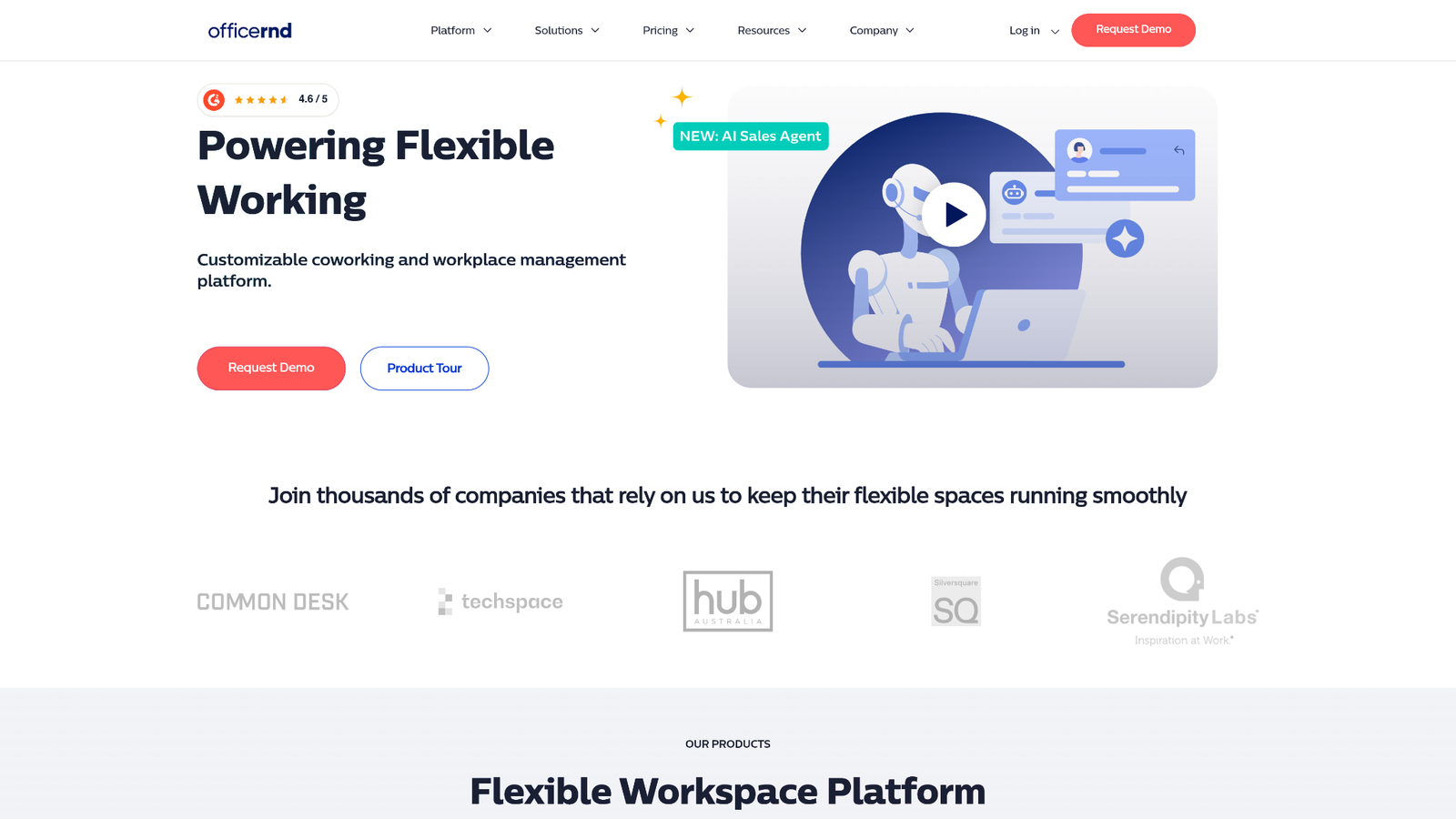
Best for: Established operators with multiple locations and enterprise-level reporting requirements.
OfficeRnD Flex has become one of the most comprehensive platforms in the coworking industry. It is designed for operators managing hundreds or even thousands of members across multiple sites.
Where it stands out is operational depth.
Instead of treating booking, billing, CRM, and analytics as separate modules, OfficeRnD connects everything into one operational system.
Core strengths
- Advanced automated recurring billing
- Deep occupancy analytics
- Flexible membership plans
- Enterprise-grade reporting
- Native visitor management
- Resource scheduling
- Powerful automation workflows
- Excellent multi-location management
- Strong API ecosystem
Its reporting dashboard goes beyond simple occupancy percentages.
Operators can analyze:
- Revenue by location
- Yield per desk
- Membership growth
- Space utilization
- Booking trends
- Churn rates
- Forecasted recurring revenue
Large operators appreciate the ability to compare performance across an entire workspace portfolio.
Limitations
- Higher learning curve
- Premium pricing
- More features than smaller operators may need
- Initial implementation takes time
Pricing structure
Custom enterprise pricing based on workspace size and operational requirements.
Ideal if: You operate multiple coworking locations and want detailed operational intelligence instead of basic booking software.
2. Nexudus
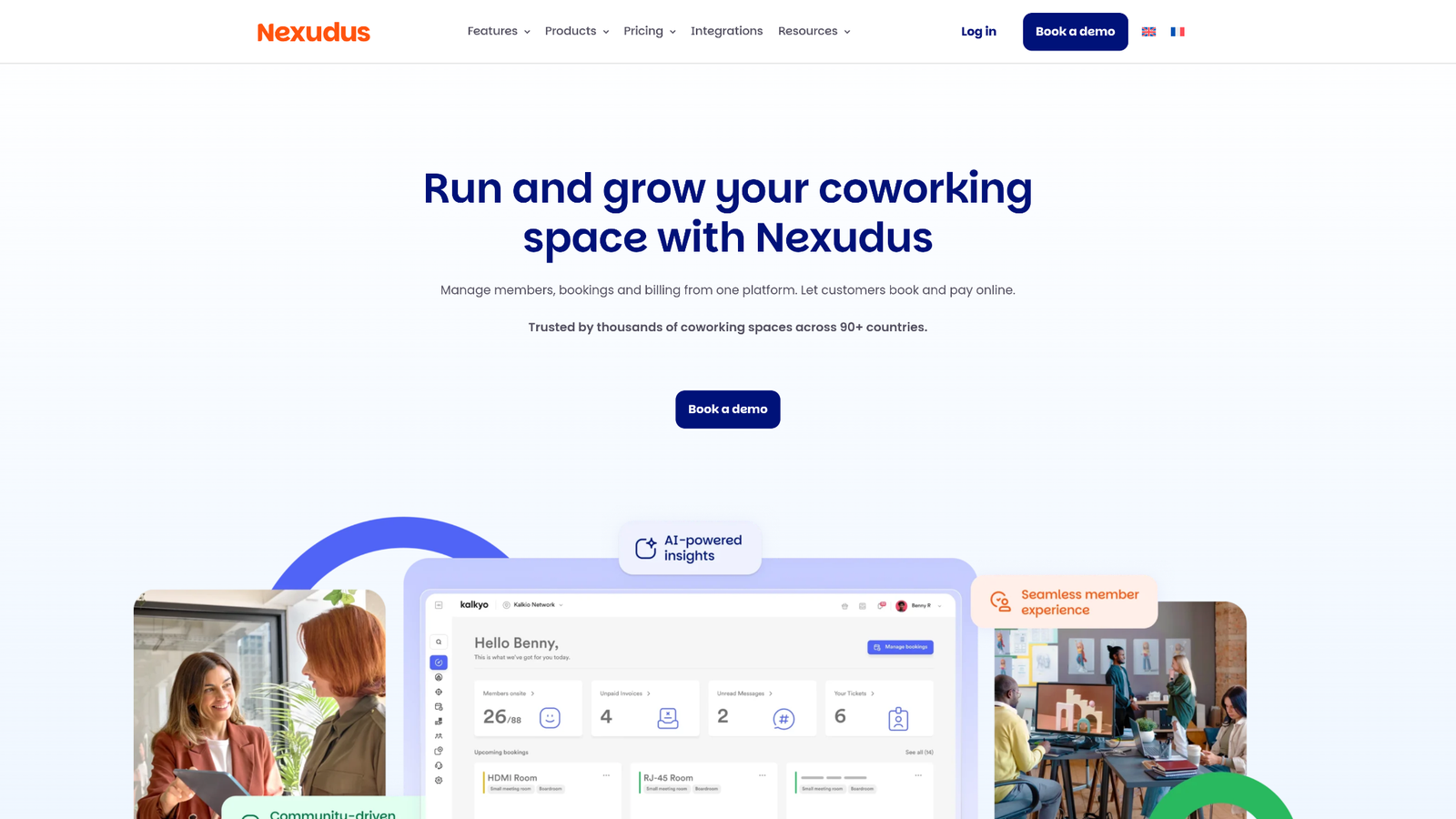
Best for: Operators wanting maximum customization.
Nexudus has long been known as one of the most configurable coworking platforms available. Nearly every workflow can be customized.
Membership rules, booking policies, invoices, customer portals, automations, permissions, and integrations can all be adapted to fit unique business models. For operators with unconventional membership structures, this flexibility is a major advantage.
Core strengths
- Extensive customization
- Large integration marketplace
- Flexible member portal
- Advanced booking rules
- Automated recurring billing
- Community management tools
- API access
- Excellent reporting
Nexudus also supports complex scenarios such as:
- Corporate memberships
- Team accounts
- Virtual offices
- Resource credits
- Event management
- Marketplace listings
Limitations
- Interface feels more functional than modern
- Configuration requires planning
- Some advanced features take time to master
Pricing structure
Custom pricing based on workspace requirements.
Ideal if: Your workspace has unique operational workflows that generic platforms cannot accommodate.
3. Optix
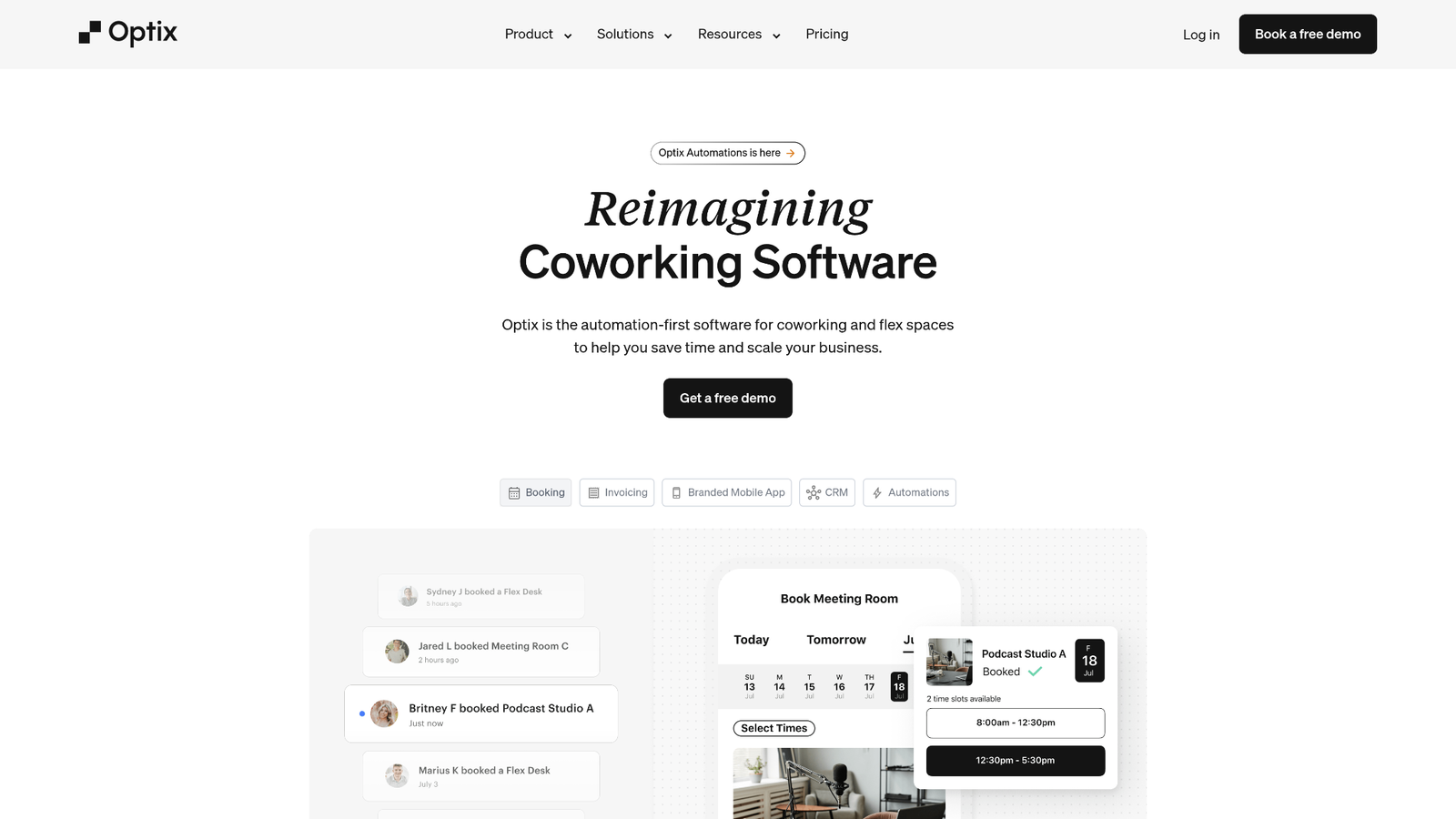
Best for: Premium coworking brands that prioritize member experience.
Optix approaches coworking from a mobile-first perspective. Instead of making operators do everything from an admin dashboard, much of the member experience happens inside a beautifully designed white-label member app.
Members can:
- Reserve desks
- Book meeting rooms
- Open doors
- Pay invoices
- Join events
- Chat with other members
- Receive announcements
The polished user experience often reduces support requests because members can complete most tasks independently.
Core strengths
- Excellent mobile experience
- Beautiful white-label branding
- Strong community engagement
- Smart booking workflows
- Integrated messaging
- Visitor management
- Modern interface
For premium spaces where brand experience matters, Optix consistently ranks among the strongest options.
Limitations
- Reporting is less comprehensive than enterprise platforms
- Limited customization compared to Nexudus
- Better suited to small and medium operators
Pricing structure
Custom pricing depending on workspace size.
Ideal if: Your competitive advantage comes from delivering an exceptional digital member experience.
4. Archie
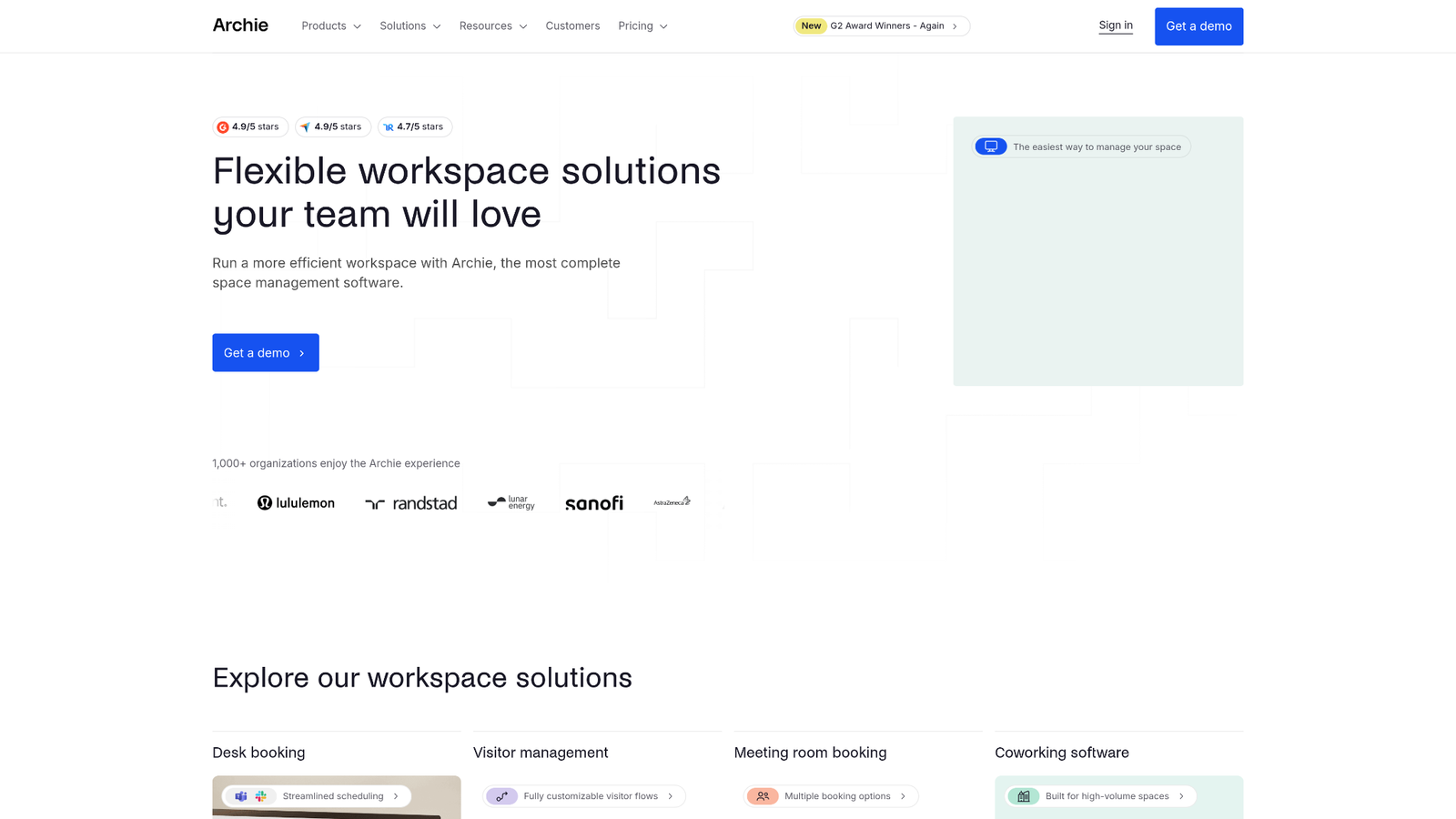
Best for: Hybrid offices and growing coworking businesses.
Archie has gained popularity because it combines workplace management with coworking operations.
It serves organizations managing:
- Flexible offices
- Shared desks
- Hybrid employees
- Visitor check-ins
- Meeting rooms
The platform is relatively quick to implement compared with larger enterprise systems.
One of its biggest advantages is transparent per-desk pricing, making budgeting easier for operators.
Core strengths
- Easy implementation
- Clean interface
- Excellent desk booking system
- Visitor management
- Hybrid workplace support
- Google and Microsoft integrations
- Strong meeting room reservation tools
Archie works particularly well for businesses transitioning from traditional offices into flexible workspaces.
Limitations
- Less advanced analytics
- Smaller ecosystem than OfficeRnD
- Fewer customization options
Pricing structure
Primarily priced per desk, with enterprise options available.
Ideal if: You want modern workspace software without the complexity of enterprise platforms.
5. Spacebring (formerly Andcards)
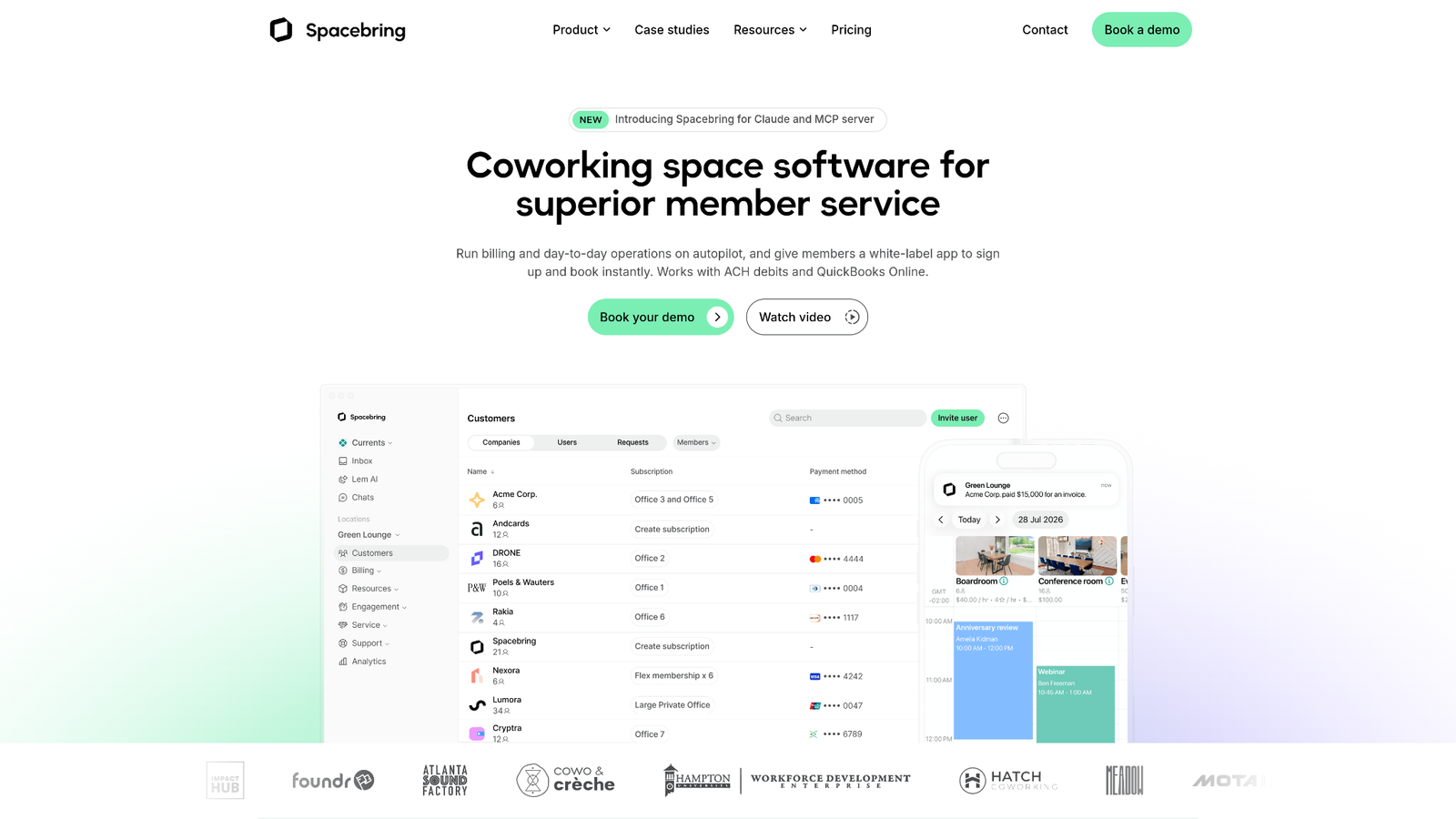
Best for: Operators looking to reduce everyday administrative work.
Spacebring focuses on simplifying daily operations rather than overwhelming operators with advanced configuration.
Its philosophy centers around self-service.
Members can independently manage bookings, invoices, announcements, and community interactions.
For small teams, this can significantly reduce repetitive administrative tasks.
Core strengths
- Quick setup
- White-label member app
- Self-service member portal
- Automated announcements
- Event management
- Desk booking
- Community directory
- Automated recurring billing
Its intuitive interface makes onboarding staff relatively straightforward.
Limitations
- Analytics aren’t as advanced
- Fewer enterprise reporting capabilities
- Limited customization for large operators
Pricing structure
Subscription plans based on workspace requirements.
Ideal if: You want practical automation that lowers day-to-day admin without a steep learning curve.
6. Cobot
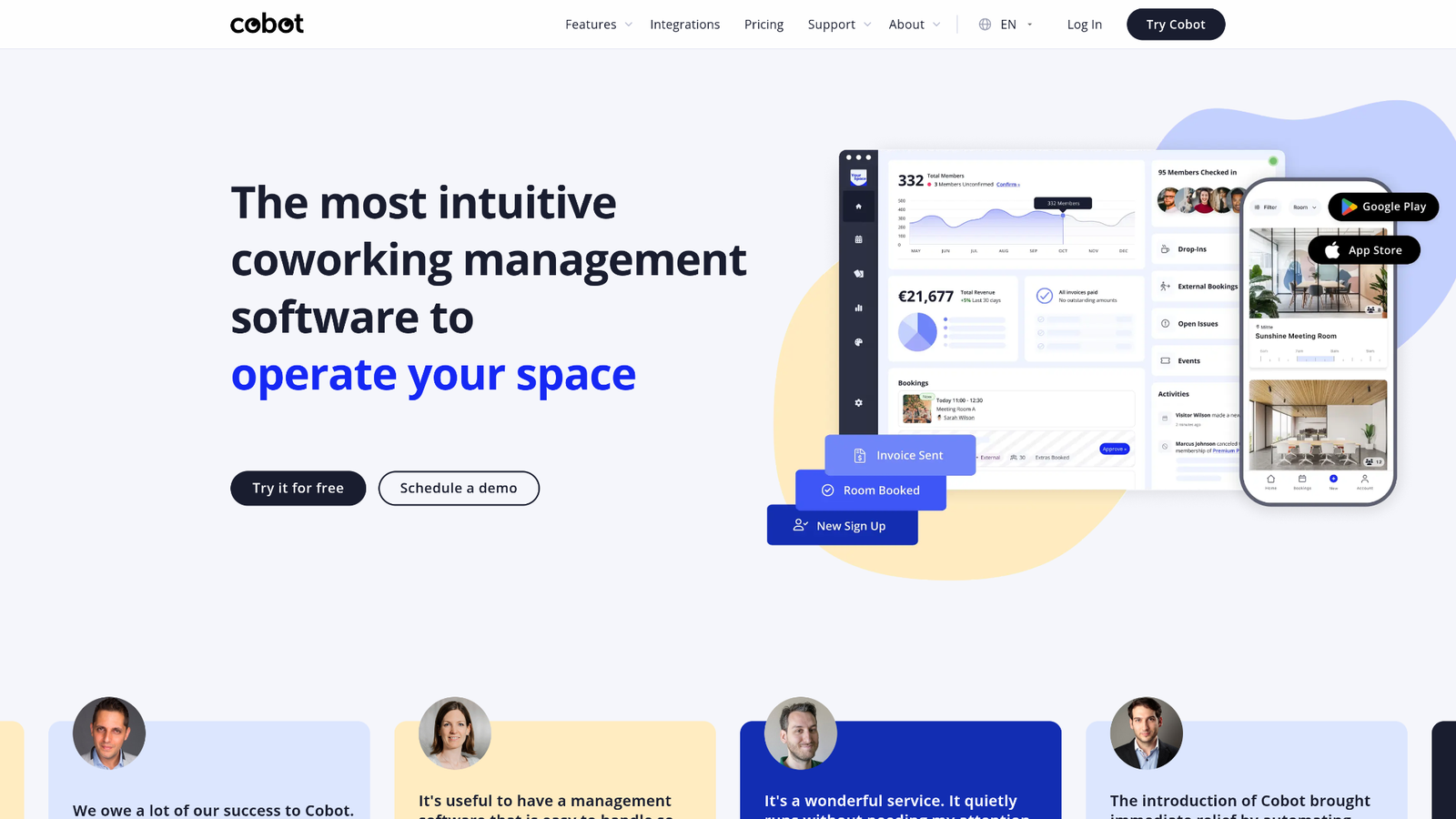
Best for: Independent coworking spaces and boutique operators.
Cobot takes a different approach. Instead of trying to be an enterprise operating system, it focuses on doing the fundamentals exceptionally well.
Many independent coworking spaces appreciate its simplicity.
Operators can manage:
- Memberships
- Billing
- Resource reservations
- Invoices
- Member communication
without navigating dozens of enterprise modules they may never use. Privacy-conscious organizations also value its straightforward architecture.
Core strengths
- Simple implementation
- Easy billing management
- Reliable subscription handling
- Lightweight interface
- Transparent operations
- Low maintenance
Limitations
- Smaller integration ecosystem
- Limited reporting
- Basic mobile experience
- Fewer automation capabilities
Pricing structure
Monthly subscription based on workspace size.
Ideal if: You run a single coworking location and value simplicity over advanced automation.
7. Coworks
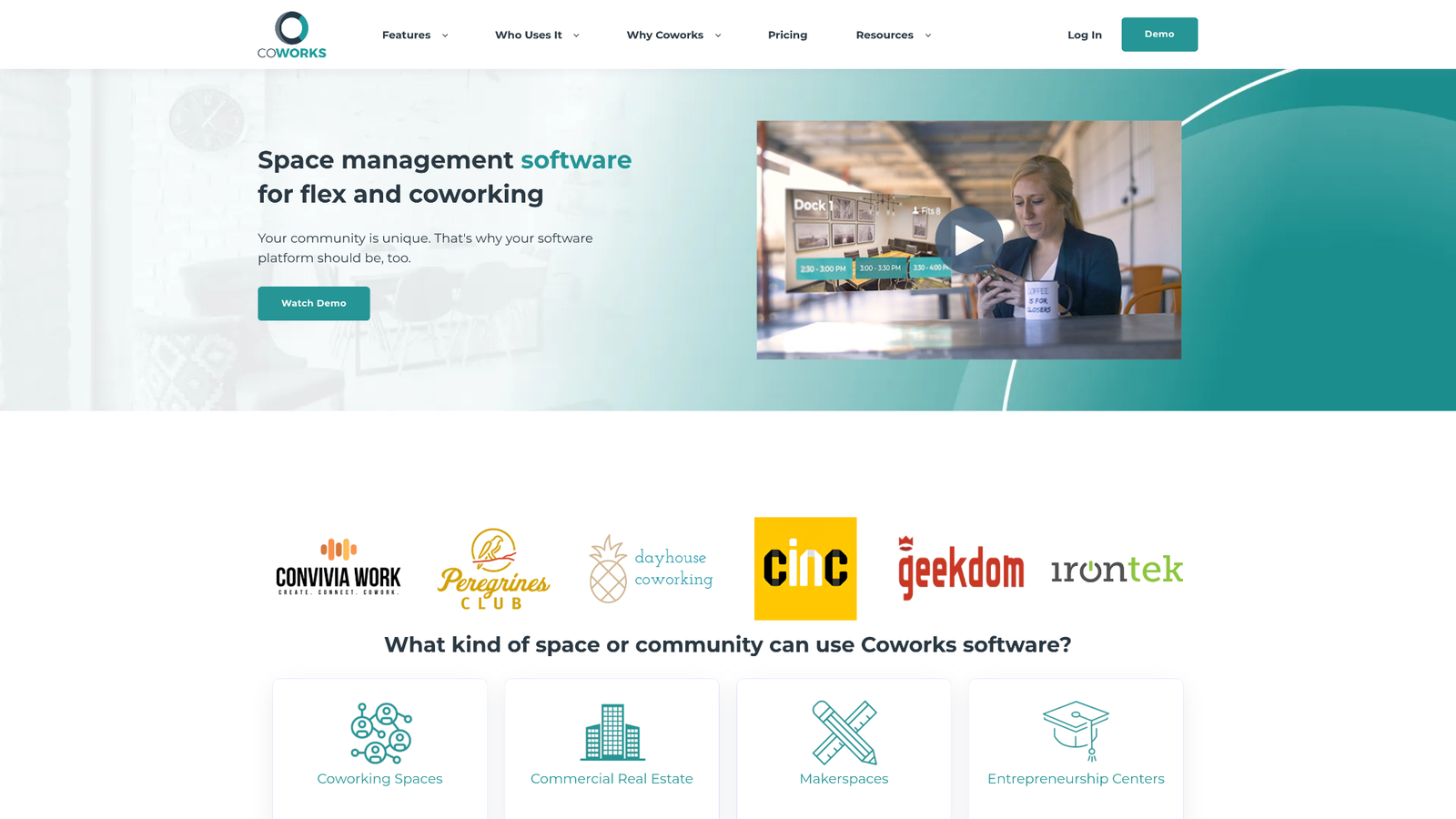
Best for: Community-driven coworking brands.
Some coworking spaces compete on location. Others compete on community. Coworks leans heavily into the second category.
Beyond membership management, it helps operators create stronger engagement through events, networking opportunities, announcements, and communication tools.
For operators who believe community drives long-term member retention, these features become a significant differentiator.
Core strengths
- Event management
- Community engagement
- Member networking
- Booking management
- Billing automation
- Member directories
- Communication tools
- Native integrations
The platform balances operational management with relationship building, making it particularly attractive for independent coworking brands.
Limitations
- Analytics less advanced than OfficeRnD
- Fewer enterprise features
- Better suited for community-led businesses than corporate flex operators
Pricing structure
Custom pricing based on organization size.
Ideal if: Your coworking space differentiates itself through networking, events, and community rather than simply renting desks.
| If you need… | Best Choice |
| Enterprise reporting and occupancy analytics | OfficeRnD Flex |
| Maximum customization | Nexudus |
| Best mobile experience | Optix |
| Transparent per-desk pricing | Archie |
| Fast deployment and lower admin effort | Spacebring |
| Simple membership management | Cobot |
| Community engagement and networking | Coworks |
Bottom line: If you’re managing multiple locations with complex memberships, OfficeRnD Flex and Nexudus offer the deepest operational capabilities. For operators prioritizing member experience, Optix and Spacebring stand out with polished self-service experiences. Smaller independent spaces often find Cobot sufficient, while Archie and Coworks strike a strong balance between operational efficiency and member engagement.
Also read: best email marketing services for nonprofits
How to Choose the Right Platform for Your Space
Most coworking platforms check the same boxes on a feature list.
The real difference is how well they fit your business model today and where you expect your workspace to be in two or three years. Before booking demos, answer these questions.
Are You Operating One Location or Planning to Scale?
A single coworking space has very different requirements from a business managing multiple properties.
If you’re running one location with fewer than 100 members, simplicity may be more valuable than enterprise functionality. A platform that’s quick to implement and easy for your staff to learn can reduce admin overhead without introducing unnecessary complexity.
If expansion is on your roadmap, prioritize software built for multi-location management. Look for capabilities such as:
- Centralized member database
- Cross-location memberships
- Shared reporting dashboards
- Standardized pricing plans
- Location-specific permissions
- Portfolio-wide occupancy reporting
Migrating platforms later is far more disruptive than choosing a scalable solution from the beginning.
Compare Pricing Models Carefully
Software pricing affects more than your monthly subscription cost. It influences how expenses grow alongside your business. The two most common pricing models are:
Per-desk pricing
Best suited for operators with relatively stable capacity.
Advantages include:
- Predictable monthly costs
- Easier budgeting
- Good for fixed workspaces
- Works well for hybrid offices
Potential drawback:
As you add more desks, software costs increase even if occupancy remains low.
Per-member pricing
Better for operators with fluctuating memberships.
Advantages include:
- Costs scale with revenue
- Lower entry costs
- Suitable for growing communities
- Ideal for flexible membership models
Potential drawback:
Rapid membership growth can increase subscription expenses faster than expected.
Ask vendors to model pricing based on your projected growth over the next 24 months rather than your current member count.
Evaluate Your Existing Tech Stack
Even excellent coworking software creates extra work if it doesn’t integrate with the tools you already rely on.
Before committing, verify compatibility with your existing systems.
Common integrations include:
Accounting
- QuickBooks
- Xero
Payments
- Stripe
Access Control
- Kisi
- Salto
- Seam
Productivity
- Google Workspace
- Microsoft 365
Native integrations generally provide a smoother experience than relying on third-party connectors or custom workflows.
Focus on Automation, Not Feature Count
Many vendors advertise hundreds of features. Most operators consistently use only a fraction of them. Instead of asking, “What features does this platform have?”
Ask:
- Can memberships renew automatically?
- Can failed payments trigger retry sequences?
- Can door permissions update instantly?
- Can members book resources without staff assistance?
- Can invoices generate automatically?
- Can reports be scheduled instead of created manually?
Every automated workflow saves staff time and reduces the risk of human error.
Prioritize Member Experience
Members compare your coworking space with every digital service they use.
A confusing booking process or outdated portal creates unnecessary friction.
Look for platforms that make it easy for members to:
- Join online
- Upgrade memberships
- Book desks instantly
- Reserve meeting rooms
- Pay invoices
- Register guests
- Access the building using mobile credentials
- Discover upcoming events
A smoother experience doesn’t just improve satisfaction. It also contributes to stronger member retention by making your space easier to use every day.
Decision tip: Build a shortlist of two or three platforms, then ask each vendor to demonstrate the exact workflows your staff performs daily. Seeing real operational tasks in action often reveals differences that feature lists don’t.
Final Thoughts
Managing a coworking space involves far more than renting desks.
You’re coordinating memberships, payments, bookings, visitor access, community engagement, reporting, and day-to-day operations, all while delivering an experience that keeps members coming back.
The right coworking membership management software brings those moving parts together into a single operational system. It reduces manual work, minimizes billing errors, improves visibility into space performance, and frees your team to focus on growing the business instead of maintaining spreadsheets.
There’s no universal “best” platform.
Frequently Asked Questions (FAQs)
How does access control integration work with membership software?
Most modern platforms integrate with electronic access systems such as Kisi, Salto, or Seam.
When someone purchases or renews a membership, the software automatically grants access based on predefined rules. If a membership expires, payment fails beyond configured retry attempts, or an account is suspended, access permissions can be revoked automatically.
This reduces manual work while improving security and ensuring that physical access stays aligned with membership status.
What is the difference between room booking software and coworking membership software?
Room booking software focuses on reserving spaces such as meeting rooms or desks.
Coworking membership management software goes much further. It combines booking with membership plans, automated recurring billing, payments, invoicing, community management, reporting, access permissions, and operational analytics.
If your business generates recurring membership revenue, a dedicated coworking platform is typically the better long-term solution.